Gourd and scraper
A dried gourd with notches cut across it — the whole instrument is the surface.
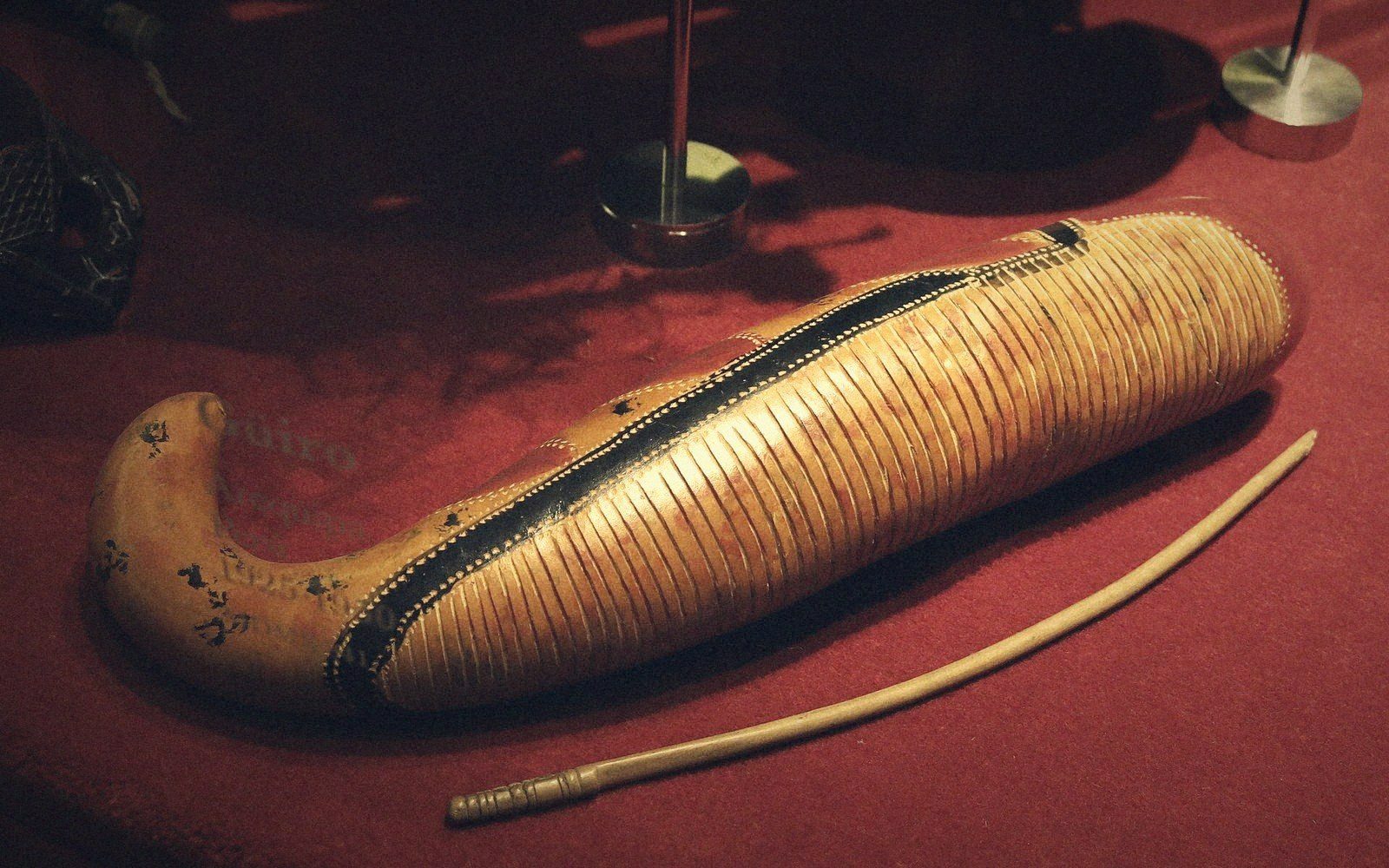
The notched surface that makes the sound
The güiro — the name most people know — is a dried gourd with a series of parallel notches rasped across its outer surface. A stick or tined scraper is drawn across those ridges, and the sound comes from both: the vibrating ridges and the gourd's hollow interior acting as a resonator. The instrument requires almost nothing to build and produces a rhythm precise enough to anchor an ensemble.
The gourd used is most often the calabash, Lagenaria siceraria, grown across tropical lowland America and dried over several months until the flesh has completely desiccated and the shell hardens to something close to wood. The drying is critical — an incompletely cured gourd cracks under the lateral pressure of the scraper, or buzzes where it should ring. Once dry, the maker drills a small hole at one end or cuts a larger opening on the underside, which releases trapped air during play and prevents the resonating chamber from deadening the ridge vibration.

The notches are cut with a knife or fine saw. Their spacing — close for a tight, chattering buzz; wider for a coarser, slower pulse — is one of the few places the maker is making a musical decision. Depth matters too: a shallow notch barely catches the scraper; cut too deep and the gourd wall weakens. A seasoned maker reads the shell's thickness before cutting, and on a thin-walled gourd keeps the notches correspondingly shallow. The scraper itself is typically a stiff wire loop, a dowel thinned at one end, or a multi-tine fork; different implements on the same surface produce different timbres from the same instrument.
The instrument has deep roots across the Caribbean basin and much of Central America. In Cuba it is central to son, guaracha and salsa timekeeping. In Puerto Rico and the Dominican Republic regional names and slight variations in shape persist — some güiros are cut from metal or fibreglass for durability on a touring schedule, though players who work in traditional contexts argue that nothing matches the sound of a well-cured organic gourd.
In South America the same scraping principle appears on instruments made from wood rather than gourd — the reco-reco in Brazil, the guacharaca in Colombia — each a local solution to the same acoustic logic: a ridged surface, a scraper and a body that amplifies.
What the instrument demonstrates is that rhythm does not require tension, pitch or resonant length. It requires only a repeated interruption of a moving surface. The gourd is merely the most efficient and available object on which that interruption can be cut.