Strings in miniature
Small high-tuned string instruments built to sit above a guitar rather than replace it.
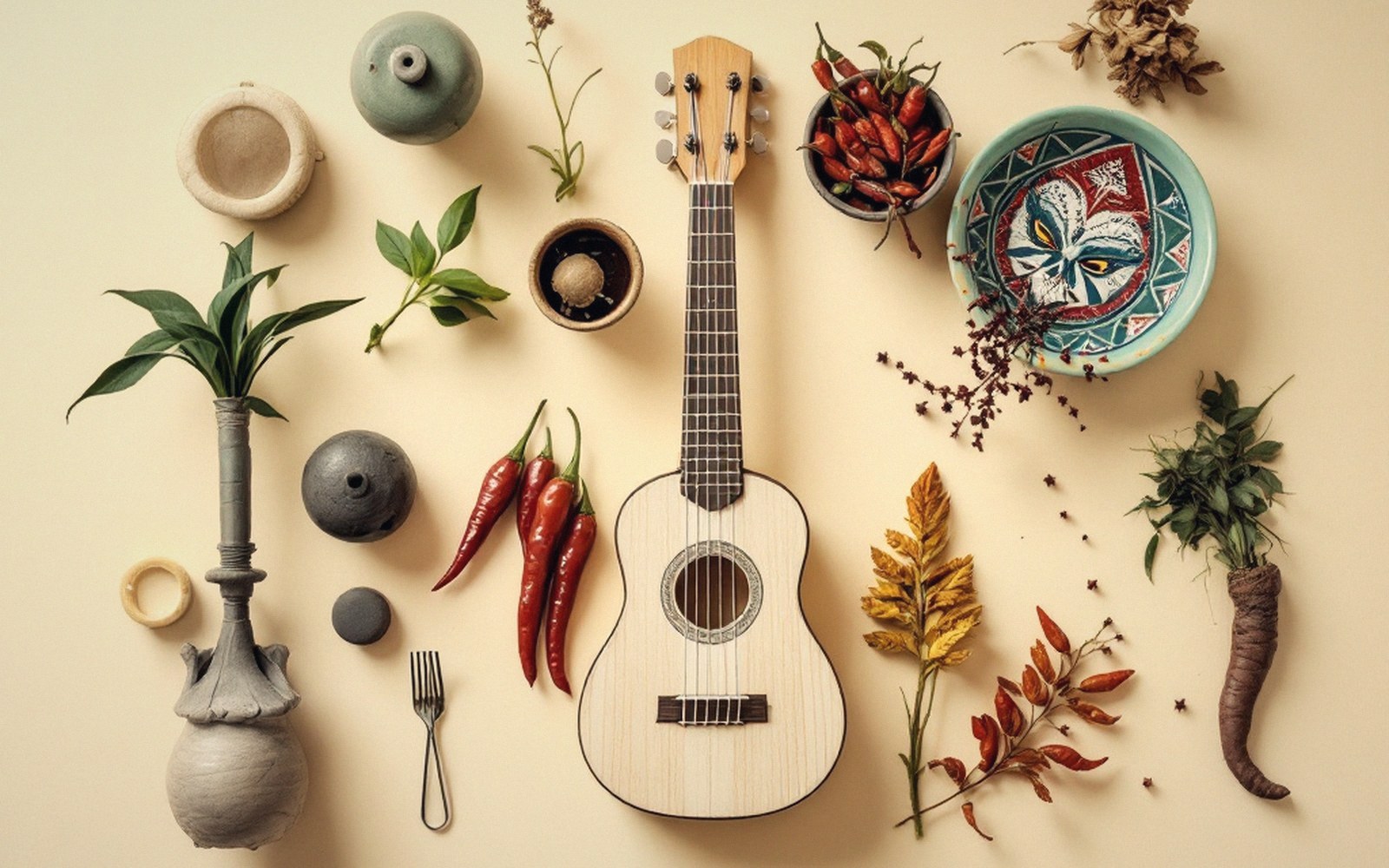
The charango and its cousins: small-bodied, high-pitched, built to cut through ensemble sound
Across the Andes and into the Pacific coastal lowlands, a family of small chordophones sits pitched an octave or more above the guitar. These instruments are not diminutive guitars. They are purpose-built voices designed to carry melody over percussion and bass in ensemble contexts where volume and penetration matter more than warmth.

How they are made and why the size is the point
The charango is the best-known member. Its body is roughly the size of a large hand — traditionally formed from the dried shell of an armadillo (quirquincho in Quechua), though carved wood has been the dominant material in urban workshop production since at least the mid-twentieth century. The top is spruce or cedar; the back, when carved, is cedar or locally available hardwoods. It carries ten strings arranged in five courses, the third course tuned in octaves, the rest in unisons. Standard tuning runs G–C–E–A–E from low to high, placing the whole register well above a guitar's first position.
The scale length is roughly 37–40 cm — short enough that the instrument must be tuned to high tension to produce a clear tone, which is precisely the point. That tension, combined with the small resonating body, generates a bright, sustaining ring that sits above rather than inside the harmonic texture of a larger ensemble. The charango was documented in the Bolivian altiplano by the late eighteenth century; by the nineteenth it had spread into southern Peru, northern Chile and northwestern Argentina.
The Andean region is not the only zone where this logic appears. On the Pacific coast of Mexico, the vihuela — a five-course instrument with a convex back, developed in the Jalisco-Colima region — fills a comparable role within the mariachi ensemble. Its body is shallower than a guitar's, its back domed rather than flat, and it is tuned to produce the strum-and-fill rhythmic texture that sits above the guitarrón's bass line. The two instruments — guitarrón and vihuela — are acoustically interdependent: neither was designed to be heard alone.
In both traditions, the small instrument's value lies in contrast. Where a guitar blends, these instruments cut. Where a bass instrument grounds the harmony, the small-bodied chordophone defines rhythm and high melody simultaneously. Workshop production in Potosí, Cochabamba, Paracho and Guadalajara supplies most instruments in circulation today, though individual luthiers continue to produce higher-grade instruments with hand-graduated tops and friction or planetary tuning pegs rather than machined geared heads.