The backstrap loom
A loom with no frame: one end tied to a post, the other to the weaver's body, tension controlled by leaning back. Portable, ancient, still in daily use, and it decides the width of everything woven on it.
A loom you wear rather than sit at
The backstrap loom has no frame, no legs, no fixed structure of any kind. One end of the loom ties to a post, a tree, a door lintel — anything that holds. The other end wraps around the weaver's lower back by means of a wide strap, usually leather or a woven band. Tension is body tension: lean back and the warp tightens; ease forward and it slackens.
The loom goes wherever the weaver goes, folds into a bundle no larger than a rolled blanket, and has been operating in essentially this form across Mesoamerica and the Andean world for at least three thousand years. Archaeological textile fragments from coastal Peru and spindle whorls and weaving tools recovered from pre-Classic Mesoamerican sites confirm a long, unbroken lineage. What changed over those millennia was not the tool but the refinement of the hand that held it.
A single weaver working a single backstrap loom produces yardage measured in months, not meters per hour.
The constraint the loom imposes is real and consequential: width. Because the warp — the set of parallel threads that run the length of the cloth — is stretched between the weaver's body and the anchor point, it can be no wider than the weaver's own arms can comfortably reach. In practice, a backstrap-woven textile is rarely more than sixty or seventy centimetres wide.
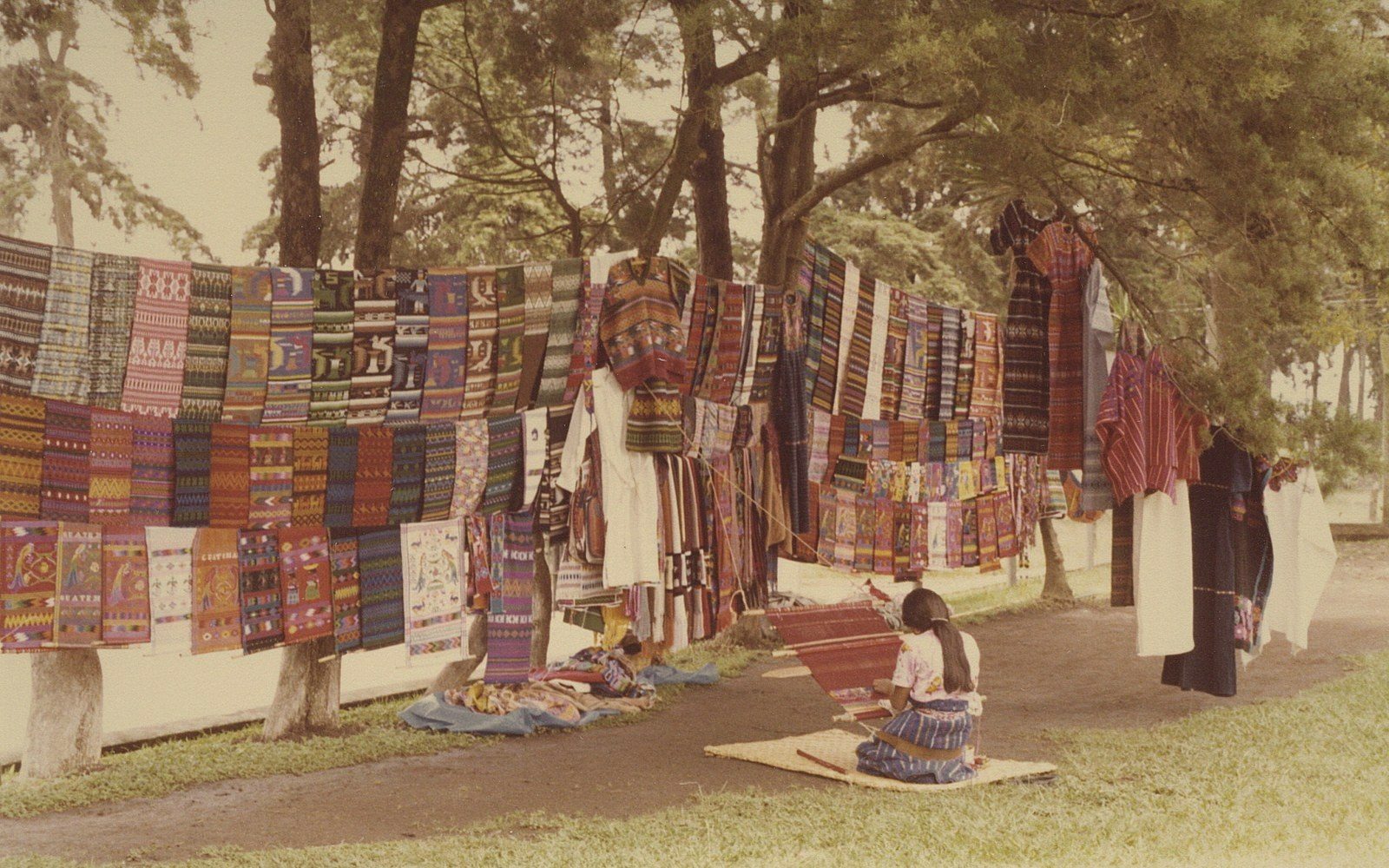
Garments made from it are built from multiple narrow panels seamed together, a construction logic that shapes indigenous dress across Guatemala, Oaxaca, Chiapas, Bolivia, and Peru. The width restriction is not a defect the tradition works around; it is a structural given that weavers have turned into a design logic, matching seam lines to motif boundaries so that the join becomes part of the pattern.
How the loom is assembled and worked
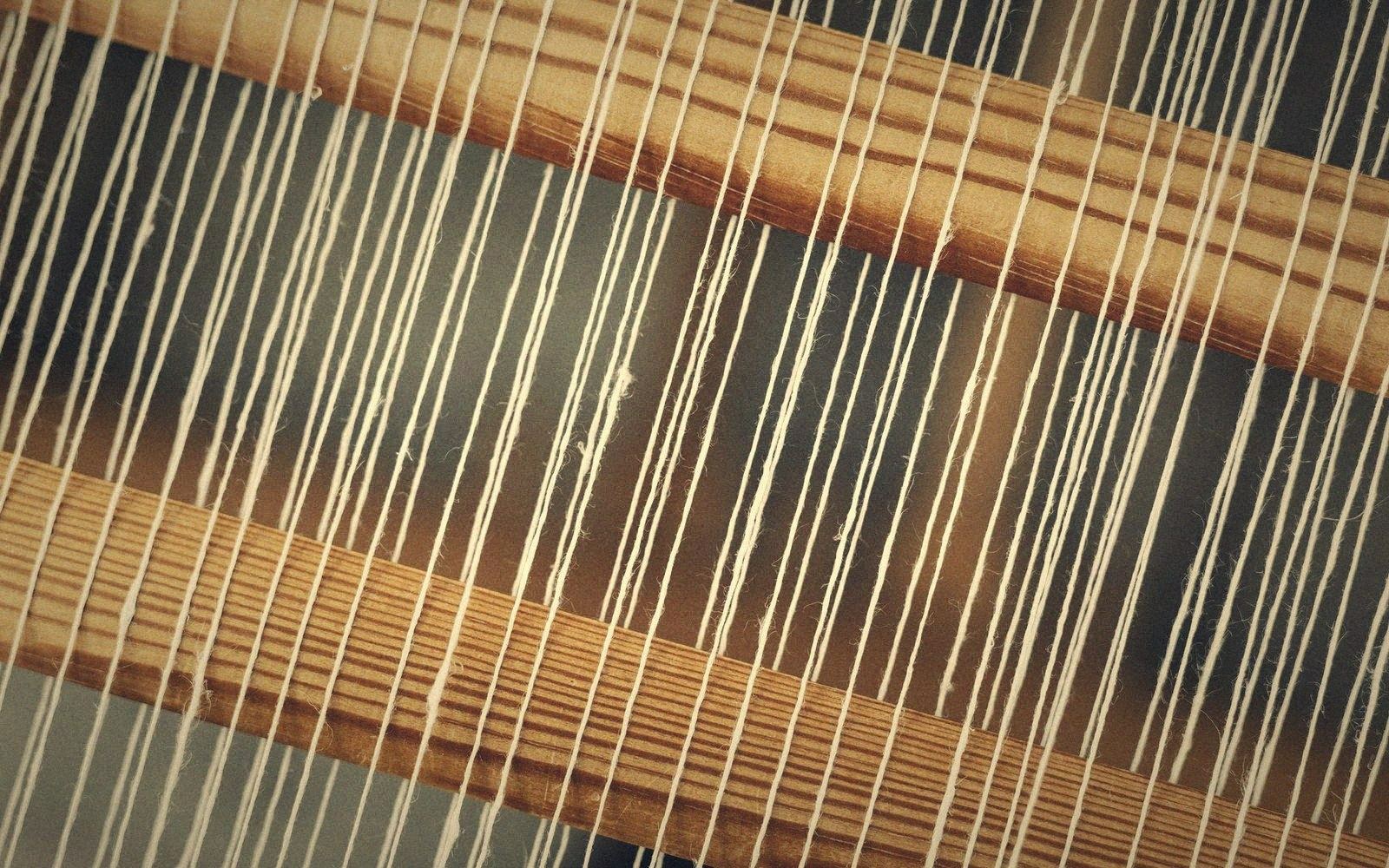
The core components are few. The warp threads run as a continuous loop between two sticks — the upper beam, which ties to the anchor, and the lower beam, which is held against the backstrap. A third stick, the shed rod, is inserted through alternate warp threads and held flat; turning it on edge opens the first shed, the gap through which the weft passes. A heddle — a looped cord that links the alternate set of warp threads to a stick the weaver can pull toward her — opens the counter-shed.
These two alternating openings, one created by the shed rod and one by the heddle, are the entire mechanical basis of plain weave. The weft thread is wound onto a slender bobbin or shuttle and passed through each shed in turn, then beaten into place with a flat beater sword, usually carved from a dense hardwood. Every backstrap loom in the region, from highland Guatemalan communities such as Santiago Atitlán and Sololá to Andean workshops in Chinchero, Peru, shares this same five-part logic: two beams, shed rod, heddle, beater.
What varies enormously is what weavers do beyond plain weave. The hands are the true mechanism. Weavers working in brocade technique — called bordado de brocado or, in some Mayan-language communities, by terms in Kaqchikel, K'iche', or Tzotzil that name both the technique and the specific motif family — pick up groups of warp threads with the fingers or a thin pointed stick while the shed is open, insert supplementary weft threads of a different colour or fiber, and create a pattern that floats across the face of the cloth without appearing on the back.
This pickup work is not incidental decoration applied over the weave; it is simultaneous with the weave, built row by row. A single design band of moderate complexity might require the weaver to count warp threads in groups of four or six across every row, keeping the pattern sequence in memory rather than from a written draft. The cognitive and muscular load is considerable, and the patterns — which carry meaning specific to a community rather than a region — are held as embodied knowledge, transmitted through practice rather than notation.
Warp-faced weave is a second major technique. Here the warp threads are beaten so closely together that they completely cover the weft, and all colour and pattern work is done in the warp. Setting up a warp-faced textile requires the weaver to wind the warp in calculated colour sequences before the loom is even dressed — a planning step that commits the design before the first weft pass.
Andean weavers, particularly in Bolivian and Peruvian highland communities, have developed warp-faced double weave and complementary-warp techniques of extraordinary intricacy, in which two complete layers of cloth are woven simultaneously, interlocked at the edges, the upper layer's pattern a photographic negative of the lower.
Fiber, dye, and the loom's relationship to both
The backstrap loom is agnostic about fiber. Cotton, the dominant fiber in lowland Mesoamerica, was being grown, spun and dyed well before European contact; its fine, stable thread produces the clean, crisp face of traditional Guatemalan huipil panels. In the Andes, camelid fiber — primarily alpaca and the finer vicuña, with llama for coarser work — gives warp-faced cloth its characteristic density and slight sheen. The two fiber traditions developed largely in parallel, shaped by altitude and climate rather than cultural preference.
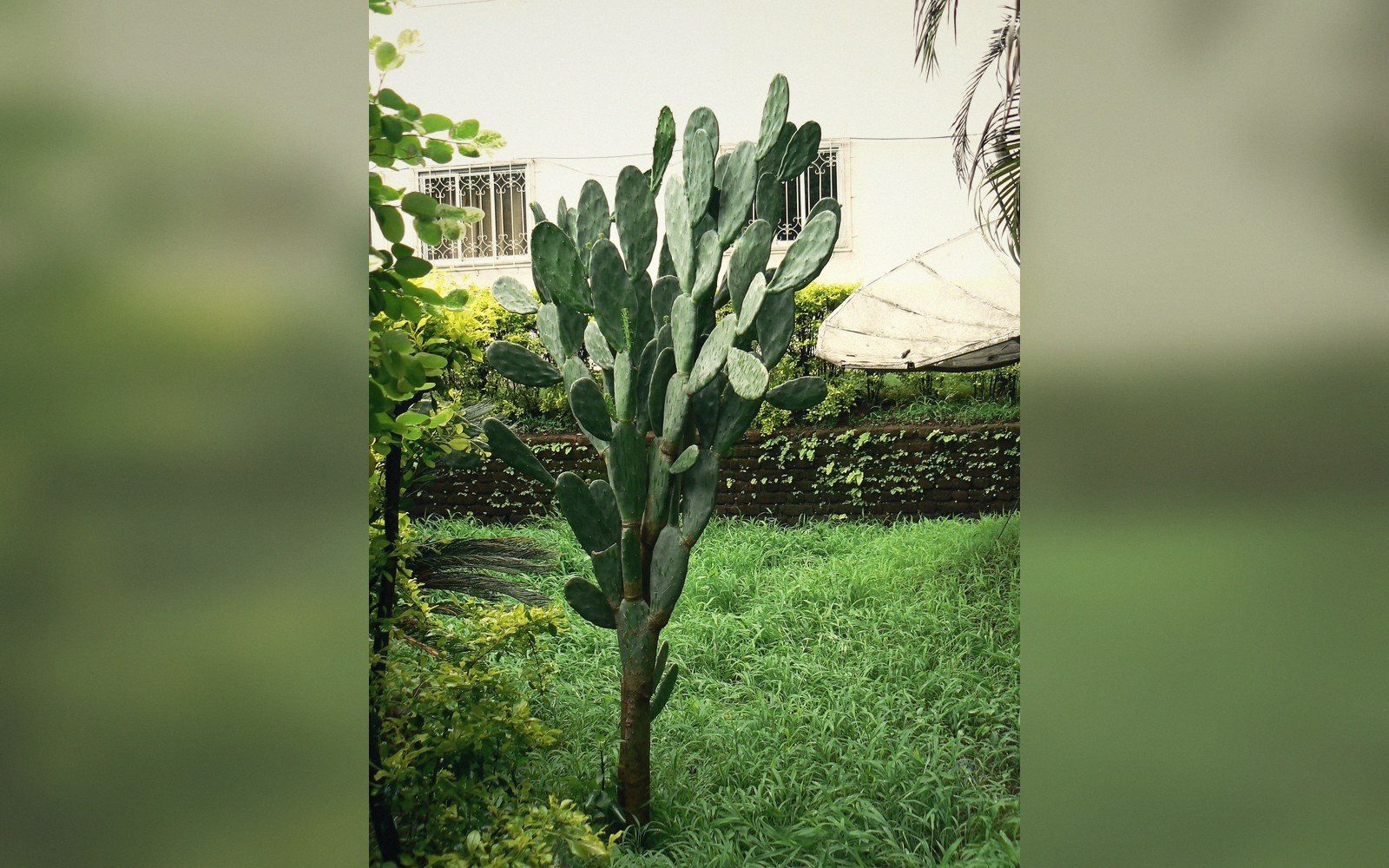
Color enters the warp before weaving. Yarn dyed with cochineal — the carmine-producing scale insect harvested from Opuntia cactus — produces the deep reds and carmines that appear throughout highland Guatemalan and Oaxacan weavings and that once made the dye one of colonial Mexico's most valuable exports. Indigo gives the blues.
Combinations of the two, used at different concentrations and sometimes mordanted with alum, tannin, or iron-rich mud, extend the palette into purples and blue-greens. The exact mordant and dye sequence can shift a color perceptibly, which is why seemingly matching threads from different dye lots sit differently in finished cloth — a characteristic that experienced weavers read as quality rather than inconsistency.
The portability of the loom creates a particular relationship between the weaver and time. Weaving is not workshop-bound; it happens in courtyards, doorways, and on the ground beside a market stall. In many communities it occupies the hours between other tasks, taken up and put down many times across a day. A complex huipil — the traditional tunic worn in much of Mesoamerica, constructed from two or three loom-width panels seamed and folded — might represent several months of these accumulated hours. The loom's portability distributes the labor through daily life rather than concentrating it.
Production scale is small by definition. A single weaver working a single backstrap loom produces yardage measured in months, not meters per hour. Commercial production on floor looms introduced after the Spanish conquest, and now on power looms, operates at a different order of magnitude entirely — which is precisely why backstrap-woven cloth is distinguishable by touch and by the slightly irregular, hand-beaten density of the weft. The variation is not imprecision; it is the record of a body, leaning and releasing, counting threads across a morning.